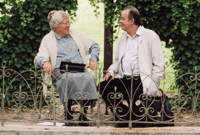
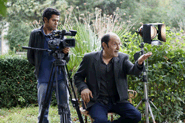
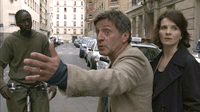
Michael Haneke’s latest offering, Caché brilliantly converges towards early Harun Farocki themes of surveillance and terrorism though images while retaining his own recurring themes on the abstraction of videoimage representation (as in The Seventh Continent), the desensitization of images (as in Benny’s Video), and the breakdown of (social) order as a consequence of failed communication […]
Tag: NYFF
Gardens in Autumn, 2006
Otar Iosseliani’s understated and reassuringly familiar abstract comedies are incisive, universal expositions on human absurdity, the complications of modern life, and the seasonality of fortune, so it is particularly satisfying to see the unremarkable (anti)hero of his latest film, Gardens of Autumn break through this corruptive and dysfunctional cycle of power, materialism, and social mobility […]
24 City, 2008
In its portrait of a culture on the verge of erasure with the advent of redevelopment and gentrification, Jia Zhang-ke’s 24 City shares kinship with José Luis Guerín’s En Construcción, reflecting the idea of a city built from the rubble of abandoned, forgotten histories. Interweaving first person and composite, fictional interviews with workers, friends, and […]
The World, 2004
Marking Jia’s first state-approved film, The World immediately bears the visual imprint of its “official”, non-underground status in its highly polished mise-en-scène: the elaborate pageantry of a flamboyant stage spectacle, ornate costuming, original electronica background compositions, and whimsical, interstitial animation sequences. Following the lives of a group of young adults working at an Epcot Center-like […]
Let It Rain, 2008
The insidious nature of racism and marginalization that underpins the discourse in It’s Hard Being Loved by Jerks also surfaces in Let It Rain, Agnès Jaoui’s third (and lightest) ensemble collaboration with screenwriter and actor, Jean-Pierre Bacri. Having scheduled a visit to her childhood home in order to help her sister, Florence (Pascale Arbillot) sort […]
Tokyo Sonata, 2008
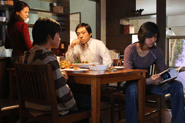
After a retreat to the atmospheric and spectral Loft and Retribution that reinforce Kiyoshi Kurosawa’s reputation as a horror filmmaker, Tokyo Sonata continues in the vein of his idiosyncratically personal (and arguably, more interesting), yet equally unsettling films that began with Bright Future. As the film begins, the family patriarch, middle-aged senior administrative manager, Ryuhei […]