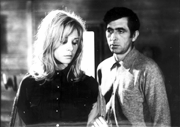
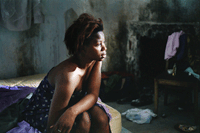
Keita, The Heritage of the Griot, 1995

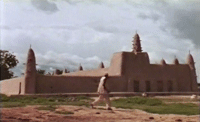
One day, in the rural village of Wagadu, a slumbering griot (traditional tale-teller) named Djéliba is visited by the spirit of an ancient hunter and oracle as he recounts in his dreams the legend of a tribesman on the dawn of civilization who rose up and proclaimed himself king of Mandé with the neutral consent […]

Gbanga-Tita, 1994/Anton Webern, 1991/Wild Blue: Notes for Several Voices, 2000

Gbanga-Tita, 1994 Defined by Thierry Knauff as a purely cinematic “moment of grace” (during his introductory remarks on the films being presented), Gbanga-Tita was initially shot as footage for his ethnographic film on the Baka pygmy of the Equatorial forest in South-East Cameroon, Baka. The film consists of a single unbroken close-up shot of Lengé, […]

Paper Planes, 1967

During his introduction to the screening of Bostjan Hladnik’s seminal film Dance in the Rain, Slovenian film scholar Joseph Valencic remarked that its modernist structure would serve as a blueprint for Slovenian filmmaking over the course of the next two decades, and this paradigm is clearly reflected in Matjaz Klopcic’s inspired, yet maddeningly (and deliberately) […]

La Question Humaine, 2007

In an interstitial episode the occurs halfway through Nicolas Klotz’s La Question humaine (Heartbeat Detector), a group of diners at a low rent café are racially profiled and rounded up by the police for a random check of identification papers, the first among them, Papi (Adama Doumbia), the African immigrant whose wife, Blandine (Noëlla Mossaba) […]

La Blessure/The Wound, 2004

The Wound (La Blessure) opens to an unhurried, long take, static shot of a man lying near motionless on the mattress on the floor of a cramped, dingy apartment, seemingly waiting for something to happen. The ringing of a telephone breaks the visual monotony of the frame as a man named Papi (Adama Doumbia) crosses […]