After two films that admittedly left me uncertain over the direction of Hou Hsiao Hsien’s cinema, it was particularly satisfying to see Hou incorporate his earlier (and specifically, more overtly political) films with his recent expositions into more distilled and highly elliptical mood pieces. Evoking Chantal Akerman’s Toute une nuit in its essential distillation of […]
Category: Directors
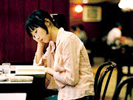
Café Lumière, 2004
Hou’s film continues in a similar vein of hermetic environment and translucently slight narrative that have come to define his later, apolitical (and largely transitional) works (beginning with The Flowers of Shanghai). Opening with the reassuringly familiar sight of the Mount Fuji Shochiku logo that can be seen at the beginning of many of Yasujiro […]
The Flowers of Shanghai, 1998
The delicate, exquisitely constructed interiors of the late nineteenth century Shanghai brothels – the flower houses – create a serene, idyllic escape for its venerated patrons. Here, in the euphemistic propriety of privileged society, madams, called ‘aunts’, arrange sexual liaisons for their flower girls through appointed bookings. The Flowers of Shanghai opens to a shot […]

Goodbye South Goodbye, 1996
Goodbye South Goodbye opens to the image of a dour and impassive entrepreneur and marginal gangster named Gao (Jack Gao), his volatile and image-conscious associate, Flathead (Giong Lim), and a lackadaisical, drug addicted occasional prostitute named Pretzel (Annie Shizuka Inoh) riding on a passenger train to an unspecified destination. Gao receives a telephone call, but […]

Good Men, Good Women, 1995
Good Men, Good Women opens with the enigmatic words, “When yesterday’s sadness is about to die. When tomorrow’s good cheer is marching towards us. Then people say, don’t cry. So why don’t we sing.” A static, monochromatic shot then focuses on a group of travelers laden with baggage, singing as they traverse the rural countryside […]
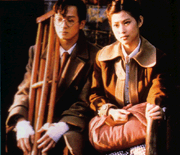
A Cty of Sadness, 1989
A City of Sadness chronicles the lives of the Lin family during the turbulent four years between the Japanese withdrawal from Taiwan (after 51 years of occupation) in 1945, to the secession of Taiwan from mainland China in 1949. The eldest brother, Wen-Heung (Chen Sown-yung), a robust man with crude manners, returns from the war […]