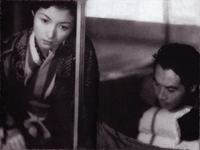
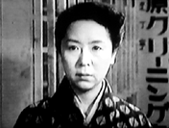
Sonosuke Asai (Benkei Shiganoya), the manager of a pharmaceutical company, begins each morning with a familiar ritual: selfishly praying for “wealth and health”; harshly berating the servants; complaining of his wife’s (Yoko Umemura) untraditional behavior. Yet, having married into prominence and career, he is unable to censure her conduct, and is compelled to submit to […]

Tag: Japanese Cinema
Flowing, 1956
Adapted from the novel by postwar author Aya Koda (the daughter of Meiji-era novelist Koda Rohan) and filmed in the same year as the banning of prostitution in Japan, Mikio Naruse’s Flowing is something of a corollary to Kenji Mizoguchi’s Street of Shame, a complex and richly textured panorama capturing a transforming way of life […]
When a Woman Ascends the Stairs, 1960
Every afternoon, a young widow named Keiko (Hideko Takamine) walks from her modest apartment to her job as a senior hostess in a Ginza bar. Compassionate and courteous, she is affectionately called “mama” by the younger hostesses who see her graciousness and charm as an unattainable ideal. At a glance, the beautiful and demure Keiko, […]
Floating Clouds, 1955
On a bleak and cold morning in November 1946, a group of weary and destitute repatriates from Indochina, insufficiently dressed for the brisk northern weather, disembarks from a Japanese port with their meager belongings for an ill-planned and unassisted government resettlement after the war. Among the returning nationals is Yukiko (Hideko Takamine), a young woman […]
Late Chrysanthemums, 1954
Late Chrysanthemums is a fascinating character study on the lives of four retired geishas in postwar Tokyo. The film opens to the rhythmic sound of tapping, as the camera focuses on the image of a clock. It is a gentle reminder of the passage of time. A cheerful, mild mannered financial adviser, Itaya (Daisuke Kato), […]
Okasan, 1952
Okasan opens to the voice of a reflective young woman named Toshiko (Kyôko Kagawa) who amusedly comments on her assiduous and determined mother Masako’s (Kinuyo Tanaka) idiosyncratic preference for short brooms as she observes her mother meticulously sweeping the floors of their modest family home. In a poor, working class Tokyo suburb in 1950, the […]