During the videotaped introduction to the film, Mamoru Oshii commented that the societies of highly developed economies have fostered a certain state of arrested development where young people, accustomed to privilege, find little motivation to move on from their current situation. This sense of stasis, cultural amnesia, and immediacy also pervades the consciousness of the […]

Tachigui: The Amazing Lives of the Fast Food Grifters, 2006
Alternately baffling in its unclassifiable lunacy, infectious in its inspired creativity, irresistible in its tongue-in-cheek audacity, and admirable in its visionary integrity, Mamoru Oshii’s deliriously off-kilter, rapid fire superlivemation animation feature, Tachigui: The Amazing Lives of the Fast Food Grifters presents an epic, cultural and socio-political survey of twentieth century history (and into the early […]
The Ceremony, 1970
In its idiosyncratically alchemic fusion of bituminous humor, fractured narrative logic, bracing social interrogation, and sublimated depictions of perverted sexuality, The Ceremony is a provocative and excoriating satire on the amorphous nature of modern Japanese identity that could only have been forged in the wake of Nagisa Oshima’s increasing disillusionment with the impotence of the […]
The Man Who Left His Will on Film, 1970
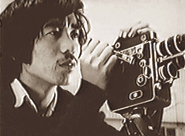
A young activist named Motoki (Kazuo Goto) comes into the view of a rolling Bolex camera as he accosts the silent, unseen operator to demand its return, arguing that the presumptuous filmmaker can shoot landscapes at any time while his need to film a nearby demonstration in order to create “a documentary of the struggle” […]
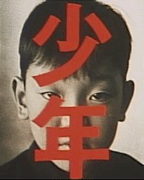
Boy, 1969
The idiosyncratic color shift of the title sequence in Nagisa Oshima’s trenchant and acerbic coming-of-age tale, Boy provides an incisive metaphor for the imbalanced natural order that lies beneath the veneer of the modernized, national recovery of post-occupation Japanese society, as a seemingly de-saturated, black and white Japanese flag prominently placed in the center of […]
Death by Hanging, 1968
A clinically presented series of stark white, unembellished placards illustrates the sobering statistical data for the overwhelming public sentiment against the abolition of the death penalty as an off-screen narrator (Nagisa Oshima) provides a snide, but impassioned rebuttal to popular opinion by presenting a objective documentary of the austere and impersonal milieu associated with the […]