Genesis prefaces to a strange and anachronistic fable of creation, as the narrator recounts a catastrophic drought that ravaged an unnamed civilization, leading to widespread disease and famine. The god dispatches an emissary with distinctively shiny shoes to take thumbprints of the inhabitants within a predefined geographic area that bounds the realm of his divine […]

Category: National Cinema
Khandahar, 1983
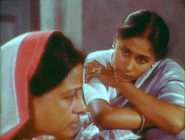
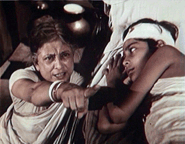
Mrinal Sen’s Khandahar (1983) is an absorbing, intelligently constructed film that centers on a blind, invalid, elderly woman (Gita Sen) of aristocratic descent who is cared for by her devoted, unmarried daughter, Jamini (Shabana Azmi) in the ancient ruins of a feudal-era zamindari (the landowner’s estate). On a Christmas holiday weekend, Jamini’s cousin Dipu (Pankaj […]
Kharij (The Case Is Closed), 1982
The second film in Mrinal Sen’s thematically connected “absence trilogy” (along with Ek Din Pratidin and Ek Din Achanak) that examine the implications of a person’s unexpected disappearance from a middle-class household on the family’s moral consciousness, Kharij expounds on the trilogy’s clinical and uncompromising social critique of entrenched, dysfunctional bourgeois values and materialistic privilege […]
In Search of Famine, 1980
Nearly a decade after the release of his three-part magnum opus Calcutta 71, Mrinal Sen would rekindle the specter of famine, exploitation, and poverty within the collective consciousness of contemporary society to create an equally haunting and introspective exposition into the nature of human suffering in In Search of Famine. Structured as a film within […]
Ek Din Pratidin, 1979
The opening shot of Ek Din Pratidin is of a rickshaw passing through the narrow alley of a deserted residential street, framed between the discolored, weather-beaten walls of a pair of dilapidated boarding houses. This curious image of decaying structure and narrowed field of view proves to be an incisive preface to the claustrophobia, entrenched […]
Calcutta 71, 1972
In the book The Essential Mystery: The Major Filmmakers of Indian Art Cinema, John W. Hood proposes that the Bengali famine in 1943 was a watershed event that would deeply mark then 20 year old Mrinal Sen and lead to his politicization and involvement with the left-leaning Indian People’s Theatre Association. In hindsight, this convergence […]