At the trenches of Biscay in 1875 during the Second Carlist War, an army sergeant named Carmelo Mendiluze (Kandido Uranga) learns from a young errand boy named Ilegorri (Ortzi Balda) that a neighbor named Manuel Iriguibel (Carmelo Gómez) from his native village has joined their exhausted battalion. Eager for news of his child’s birth, Carmelo […]
Category: National Cinema
The Headless Woman, 2008
In retrospect, the swooning, haunted enigma of Lucrecia Martel’s The Headless Woman is revealed in the metaphoric image of a landscaper digging around in frustration along the perimeter of a garden bed, trying to make room for ornamental trees that the owner, Verónica (María Onetto) had purchased during a recent trip to the nursery. The […]
The Holy Girl, 2004
In the film’s understatedly realized catalytic encounter, an adolescent named Amalia (Maria Alché) stands in front of a musical instrument shop window in order to watch a musician perform on a theremin, as an inscrutable physician named Dr. Jeno (Carlos Belloso), visiting from out of town for a medical convention, casually places his hands in […]
Remembrance of Things to Come, 2001
A visual essay into – or more appropriately, a thoughtful process of signification for – a montage of photographs from Denise Bellon’s photo-reportage from the period between the two world wars (as the “grand illusion” of a lasting peace during the mid 1930s after the Great War gradually unraveled to reveal an inexorable path towards […]
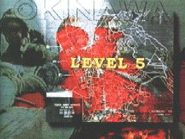
Level Five, 1997
Exploring similar territory as Russian filmmaker Aleksandr Sokurov on the continuity of collective history, spiritual desolation, and immanence, Level Five also serves as a thoughtful and reverent homage to Alain Resnais’ films on the interpenetration of memory and the subconscious. Presented as a series of video feed confessionals by a woman (Catherine Belkhodja) to her […]
The Last Bolshevik, 1993
The Last Bolshevik opens to an insightful and relevant excerpted passage from author and critical thinker George Steiner’s book, In Bluebeard’s Castle: Some Notes Towards the Redefinition of Culture: “It is not the literal past that rules us [save, possibly, in a biological sense]. It is images of the past.” Composed in the structure of […]