One of the recurring ideas that resurfaces from the Q&A with David Lynch after the screening of Inland Empire was the sense of liberation that high definition digital video afforded him, and this democratization of the medium can certainly be seen in the film’s mind-bending, sprawling, opaque, hallucinatory, sinuous, and harrowing exploration of identity, performance, […]
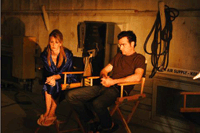
Category: Directors
Let’s Dance, 2007
Noémie Lvovsky returns to the idiosyncratic, subtly modulated multigenerational human comedy of Les Sentiments with a more diluted, but still insightfully rendered examination of aging, identity, and the changing role between parent and child in Let’s Dance (Fait que ça danse!). Lvovsky’s affectionate portrait centers on the sprightly, Holocaust survivor Salomon Bellinsky (Jean-Pierre Marielle) who, […]
Les Sentiments, 2003
Les Sentiments is a richly textured, humorous, deceptively lyrical, emotionally lucid, and intelligently crafted exposition on the dynamics of love, marriage, fidelity, and attraction. The film chronicles the genial and affectionate interaction between a happily settled, middle-aged couple, Jacques (Jean-Pierre Bacri) and Carol (Nathalie Baye), and their young, overly amorous tenants, a newly married couple […]
Rose Lowder: Short Films (1982-1995)
Les Tournesols, 1982 In some ways, Rose Lowder’s Les Tournesols, a kinetic, color-saturated, Vincent Van Gogh-esque structural film could just as easily have fit Jean-Luc Godard’s description of “blind, trembling pans” as interior representations of the artist’s psychological state (as Godard once described Alain Resnais’ Van Gogh). Composed of frame by frame stationary shots of […]
Sari’s Mother, 2006
As in Eva Mulvad and Anja Al-Erhayem’s Enemies of Happiness, James Longley’s Sari’s Mother, the edited “fourth fragment” from Iraq in Fragments, is a sobering portrait of the pervasive confusion and uncertainty that continues to define everyday life under postwar occupation, and its unseen toll on the weakest and most vulnerable. In this segment, Longley […]
Iraq in Fragments, 2006
Composed of three self-contained chapters that integrally represent the figurative image of the country divided, not only by ethnic and religious sectarianism, but also by the further destabilization of an undefined and politically – and culturally – intrusive occupation, James Longley’s Iraq in Fragments exquisitely fuses the aesthetics of Godfrey Reggio in the artful presentation […]