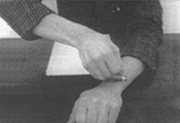
“When you have no money for cars, for shoot-outs, for smart clothes; when you have no money for images which themselves could paper the cracks of film-time, film-life, then you must invest your strength in the intelligence to connect the separate elements – the montage of ideas.” In the opening sequence of Between Two Wars, […]
Tag: Essay Film
Inextinguishable Fire, 1969
“How can we show you napalm in action? And how can we show you the injuries caused by napalm? If we show you pictures of napalm burns, you’ll close your eyes. First you’ll close your eyes to the pictures. Then you’ll close your eyes to the memory. Then you’ll close your eyes to the facts. […]
Workingman’s Death, 2005
Michael Glawogger pulsing, ambitiously conceived global treatise on the drudgery, and often dehumanizing, rituals of manual labor at the beginning of 21st century – over a century after the birth of the Industrial Revolution – appropriately begins in the town of Donbass in the Ukraine, the coal mining town where, in 1935, Aleksei Grigorievich Stakhanov […]
Our Daily Bread, 2006
Evoking the aesthetics of Harun Farocki’s antiseptic images of production crossed with Chantal Akerman’s structuralist ruminations on organic landscape, Nikolaus Geyrhalter’s Our Daily Bread is a bracing, surreal, sobering, and strangely transfixing exposition into the dehumanized technologies and industrially engendered process efficiencies intrinsic in the mass commerce of industrial-scale food production. Composed of a series […]
Elsewhere, 2001
In 2000, the final year of the twentieth century, Nikolaus Geyrhalter and his crew set out with a digital video camera to film twelve, self-contained ethnographic episodes, each encapsulating a month-long document of the lives of people who perform their quotidian rituals in a figurative “elsewhere” – distant cultures and remote geographies seemingly left untouched […]
Washed Ashore, 1994
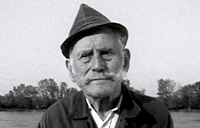
An elderly cemetery caretaker, Josef Fuchs, impassively looks out into the Danube River before turning to face the camera and reciting Count Albrecht Graf Wickenburg’s requiem for the namenlos – the unidentified dead, often people who committed suicide or lost their lives in boating accidents, whose bodies have washed up along the riverbank over the […]