After Many a Summer Dies the Swan: Hybrid (Yvonne Rainer) Juxtaposing a series of narrative text that describe the evolution of art and culture in fin-de-siècle Vienna (using historically analytical sources such as Carl Schorske’s Fin-de Siècle Vienna: Politics and Culture, Robert Musil’s The Man Without Qualities, Volume 1, and Allan Janik and Stephen Toulmin’s […]
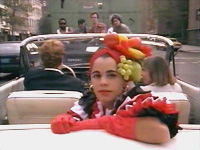
Privilege, 1990
A middle-age documentary filmmaker named Yvonne Washington (Novella Nelson) invites a long-time friend and former dancer, Jenny (Alice Spivak), ostensibly to film a candid and open dialogue on the subject of menopause. As the interview begins, Jenny makes a cursory remark on the effectiveness of an activist, Helen Caldicott’s (Yvonne Rainer) heavy-handed, incendiary speech on […]
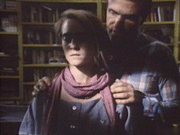
The Man Who Envied Women, 1985
Words as a means of individual expression can be a potent form of seduction. But words strung together as interchangeable syntactic cues towards a coded, contemporary social language can also transform the intrinsic materiality of words into an irrelevant – and incoherent – empty abstraction. The identification of this threshold between langue (language) and parole […]

Journeys from Berlin, 1980
When Yvonne Rainer began developing her exposition on such seemingly disconnected themes as terrorism, alienation, division, and psychoanalysis in the early 1970s as a result of her first-hand experience as an expatriate – and in particular, an American – artist in (West) Berlin, the idea of domestic terrorism and the specter of 9/11 had not […]
Film About a Woman Who…, 1974
An extended silent sequence of a picture-perfect family posing stiffly and formally before a stationary camera on an open field illustrates the deliberateness and artifice of the idealized image. It also underscores the act of performance in creating the illusion of happiness. The first image is of dual alienation: people watching something (later revealed to […]

Behave, 2006
Continuing in the vein of Justice, Maria Ramos’s examination of the Brazilian justice system, Behave is an equally potent and sobering social inquiry into the state’s juvenile re-socialization program. Working within the limitations of protecting the identity of the young offenders’ identities, the film is predominantly shot facing Judge Luciana Fiala, a conscientious juvenile court […]