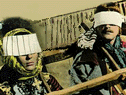
A traditional Georgian folktale recounts the story of a powerful medieval overlord who sought to fortify the most vulnerable territory within his vast and far-reaching empire, the remote kingdom of Surami, through the envisioned construction of the formidable Suram Fortress. However, the completion of the ambitiously conceived, large-scale fortification project soon proves to be elusive […]

Category: National Cinema
The Color of Pomegranates (Sayat Nova), 1968
The Color of Pomegranates conveys the life of Sayat Nova, an Armenian troubadour, through lyrical, poetic, and beautifully constructed imagery. But how does one begin to describe the viewing experience of such an iconoclastic film? After all, Sergei Paradjanov is fundamentally an artist, experimenting with film as a moving canvas. In contrast to the minimalist, […]
Shadows of Forgotten Ancestors, 1964
Shadows of Forgotten Ancestors has often been described as a Carpathian Romeo and Juliet – that is, if Romeo had the tenacity to live after his beloved’s death. Sergei Paradjanov prefaces the tragic tale set in the Carpathian mountains as the land “forgotten by God and men”, and from the austerity of the environment, it […]
Beneath Her Window, 2003
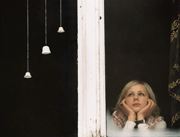
Another pleasant surprise from the Slovenian cinema series was Metod Pevec’s lovely, slow brewing Beneath Her Window, a film vaguely reminiscent of Krzysztof Kieslowski’s cinema (especially A Short Film About Love) in its interconnecting themes of obsession, missed connection, voyeurism, and chance, but played with the muted, idiosyncratic humor of a French romantic comedy. As […]
Under the Sun of Satan, 1987
Under the Sun of Satan opens to an inherently solemn ritual as a senior priest, Canon Menou-Segrais (Mauric Pialat) shaves a spot on the top of the head of a pensive young priest named Father Donissan (Gérard Depardieu) who, in turn, uses the occasion to express his feelings of profound estrangement and inutility from the […]
L’Enfance nue, 1968
Part autofiction in its reflexive tale of emotional abandonment and part social realism in its clinical illustration of the nation’s overtaxed foster care system, Maurice Pialat’s L’Enfance nue finds greater kinship with Jean Eustache’s studies on hybrid modes of representation than with a deconstructed cinéma du papa that François Truffaut’s involvement as the film’s co-producer […]