Every afternoon, a young widow named Keiko (Hideko Takamine) walks from her modest apartment to her job as a senior hostess in a Ginza bar. Compassionate and courteous, she is affectionately called “mama” by the younger hostesses who see her graciousness and charm as an unattainable ideal. At a glance, the beautiful and demure Keiko, […]
Category: National Cinema
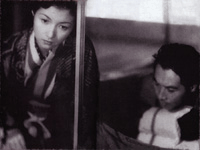
Floating Clouds, 1955
On a bleak and cold morning in November 1946, a group of weary and destitute repatriates from Indochina, insufficiently dressed for the brisk northern weather, disembarks from a Japanese port with their meager belongings for an ill-planned and unassisted government resettlement after the war. Among the returning nationals is Yukiko (Hideko Takamine), a young woman […]

Late Chrysanthemums, 1954
Late Chrysanthemums is a fascinating character study on the lives of four retired geishas in postwar Tokyo. The film opens to the rhythmic sound of tapping, as the camera focuses on the image of a clock. It is a gentle reminder of the passage of time. A cheerful, mild mannered financial adviser, Itaya (Daisuke Kato), […]
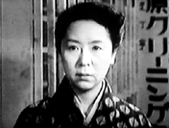
Okasan, 1952
Okasan opens to the voice of a reflective young woman named Toshiko (Kyôko Kagawa) who amusedly comments on her assiduous and determined mother Masako’s (Kinuyo Tanaka) idiosyncratic preference for short brooms as she observes her mother meticulously sweeping the floors of their modest family home. In a poor, working class Tokyo suburb in 1950, the […]

Wife! Be Like a Rose!, 1935
In Nippon Modern: Japanese Cinema of the 1920s and 1930s, Mitsuyo Wada-Marciano cites the contradictory delineation between urban and provincial life in Mikio Naruse’s Wife! Be Like a Rose! as an example of interwar Japan’s amorphously defined domestic and social spaces that arose from society’s ambivalence towards the rapid pace of modernization in the aftermath […]
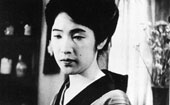
Every Night’s Dreams, 1933
Mikio Naruse’s elegantly distilled early silent film Every Night’s Dreams provides an archetype for the filmmaker’s recurring themes: pragmatic, determined women who tenaciously hold onto their failing relationships, weak men who lead a life of increasing dependence on the women they mistreat, life stations that grow baser as characters paradoxically strive to improve their situation. […]