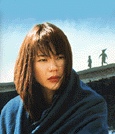
An elderly woman (Kikuko Hashimoto) abstractedly walks down the sidewalk of a high traffic bridge, as she often does, determined to return to her childhood village. Her granddaughter chases after her, imploring her to come home, but she continues to walk on. When evening comes, the grandmother’s idiosyncratic ritual becomes cause for concern when she […]
Category: Directors
Samurai Rebellion, 1967
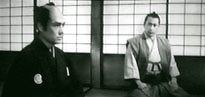
In a time of sustained peace, the powerful daimyo (feudal warlords) have become resigned to an existence of pointless exercises and petty bureaucracy in a determined effort to retain privilege and curry favors from Edo. In an attempt to stave off boredom, Lord Matsudaira’s (Tatsuo Matsumura) seasoned swordsman, Isaburo Sasahara (Toshirô Mifune) and his trusted […]
Seppuku/Harakiri, 1962
The retainer log book for the Official Residence of Lord Iyi reports that at midday on an otherwise uneventful day on the thirteenth of May 1630, during the absence of the Honorable Heir Bennosuke, a gaunt, former retainer of the Lord of Geishu arrives at the mansion gates and is granted an interview with the […]
The Human Condition, 1959-1961
Masaki Kobayashi’s six-part magnum opus, The Human Condition, based on Junpei Gomikawa’s postwar novel, bears the imprint of Kobayashi’s tutelage under legendary filmmaker Keisuke Kinoshita at Shochiku’s Ofuna studio, a critical, introspective, and deeply personal account of wartime Japan framed from the perspective of an idealistic everyman (and Kobayashi’s alterego), Kaji (Tatsuya Nakadai). Opening to […]
Gbanga-Tita, 1994/Anton Webern, 1991/Wild Blue: Notes for Several Voices, 2000
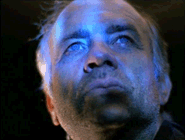
Gbanga-Tita, 1994 Defined by Thierry Knauff as a purely cinematic “moment of grace” (during his introductory remarks on the films being presented), Gbanga-Tita was initially shot as footage for his ethnographic film on the Baka pygmy of the Equatorial forest in South-East Cameroon, Baka. The film consists of a single unbroken close-up shot of Lengé, […]
The Assault of the Present on the Rest of Time (The Blind Director), 1985
Curiously opening near the end of the second act of Tosca as the heroine (Maria Slatinaru) fends off the advances of Scarpia (Günther Reich), the corrupt police commissioner, the unexpectedly abrupt, in medias res performance of the Puccini opera provides an incisive prelude to the elliptical structure of Alexander Kluge’s “anonymous city” symphony, The Assault […]