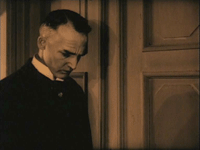
The President, 1919

It perhaps comes as no surprise, given Carl Theodor Dreyer’s lifelong, idealized melancholy over his own unresolved parentage, that the scenario selected for his first film, The President would involve three generations of children conceived out of wedlock, and thematically crystallize on the legacy of their unreconciled paternity in the resolution of their own disparate […]
Nathaniel Dorsky: Winter and Sarabande (2008)

Bookending with representations of twilight – an opening shot of light transmitted through a foregrounding grating, and a closing shot of the sun setting below a line of trees – Nathaniel Dorsky’s Winter and Sarabande convey forms of progression: a movement from dawn to dusk, shadow to light, grey tones to color, emptiness to space. […]

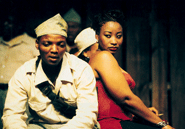
U-Carmen eKhayelitsha, 2005

The 13th New York African Film Festival’s opening night selection is Mark Dornford-May and the Dimpho Di Kopane South African Film and Lyric Theatre Ensemble’s gorgeous, sultry, bawdy, offbeat, and invigorating re-adaptation of Georges Bizet’s iconic Sevillian gypsy opera Carmen set in a modern day cigarette factory in the South African industrial town of Khayelitsha, […]

La Peine perdue de Jean Eustache, 1997

Angel Díez’s reverent and elegiac rumination on the iconoclastic, deeply personal cinema of Jean Eustache, La Peine perdue de Jean Eustache (The Lost Sorrows of Jean Eustache) hews closer to essay film than straightforward documentary, a muted, brooding tone piece where loss, grief, and mourning are reflected in the images of empty spaces, fragmented figures, […]

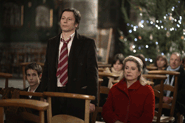
A Christmas Tale, 2008

Returning to the recurring themes of parental alienation and surrogacy of La Vie des morts, Playing “In the Company of Men”, and Kings and Queen, A Christmas Tale is a quintessential Arnaud Desplechin film in its ingenious, heady collision of disparate, often contradictory, yet integrally interconnected forms. On one level is the intersection of savior […]