A Lake, 2008

With a Russian cast, minimal French dialogue, and geographically ambiguous setting, Philippe Grandrieux’s A Lake (Un Lac), like his multilingual preceding film, La Vie nouvelle, expounds on the notion of a borderless cinema – one that not only dismantles the man-made frontiers between nations and cultures, but also the boundaries between image and sound, material […]

Stranger Comes to Town, 2007

In Stranger Comes to Town, Jacqueline Goss returns to the themes of alterity and cultural disconnection of How to Fix the World to create an equally charming, humorous, and incisive rumination on the absurdity and moral ramifications of ethnic profiling in a post 9/11, terrorist-conscious society. In one episode, a characteristically neutered Department of Homeland […]

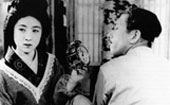
Woman of the Mist, 1936

In the essay Woman of the Mist and Gosho and the 1930s from the book Reframing Japanese Cinema: Authorship, Genre, History, Arthur Nolletti examines the complex narrative and visual strategies employed by Heinosuke Gosho that culminate in what would become one of his most accomplished works. Perhaps the most indicative of this style is his […]

The Neighbor’s Wife and Mine, 1931

Heinosuke Gosho’s The Neighbor’s Wife and Mine is a breezy and effervescent slice-of-life comedy on a harried – and easily distracted – freelance writer (Atsushi Watanabe) whose deadline for a commission work to write a play for a theater company in Tokyo is quickly approaching. Scouting for a suitable retreat where he can complete his […]

Workingman’s Death, 2005

Michael Glawogger pulsing, ambitiously conceived global treatise on the drudgery, and often dehumanizing, rituals of manual labor at the beginning of 21st century – over a century after the birth of the Industrial Revolution – appropriately begins in the town of Donbass in the Ukraine, the coal mining town where, in 1935, Aleksei Grigorievich Stakhanov […]