A Lake, 2008

With a Russian cast, minimal French dialogue, and geographically ambiguous setting, Philippe Grandrieux’s A Lake (Un Lac), like his multilingual preceding film, La Vie nouvelle, expounds on the notion of a borderless cinema – one that not only dismantles the man-made frontiers between nations and cultures, but also the boundaries between image and sound, material […]


La Vie nouvelle, 2002

While Sombre embodies the categorization of quasi-allegorical gothic fairytale, La Vie nouvelle can be described as quasi-mythological in its underlying plot. Implementing a slow reveal from darkness to a jittery, contextually ambiguous image that similarly occurs in the opening sequence of Sombre (in this film, of anonymous women’s faces staring out into space), the effect […]

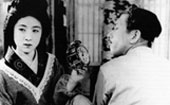
Woman of the Mist, 1936

In the essay Woman of the Mist and Gosho and the 1930s from the book Reframing Japanese Cinema: Authorship, Genre, History, Arthur Nolletti examines the complex narrative and visual strategies employed by Heinosuke Gosho that culminate in what would become one of his most accomplished works. Perhaps the most indicative of this style is his […]

The Neighbor’s Wife and Mine, 1931

Heinosuke Gosho’s The Neighbor’s Wife and Mine is a breezy and effervescent slice-of-life comedy on a harried – and easily distracted – freelance writer (Atsushi Watanabe) whose deadline for a commission work to write a play for a theater company in Tokyo is quickly approaching. Scouting for a suitable retreat where he can complete his […]

Shadow Kill, 2002

Exploring similar human rights issues as Nagisa Oshima’s Death By Hanging on the sociopolitical framework that lies beneath the inequitable administration of justice and capital punishment, Shadow Kill is told from the perspective, not of the condemned but of the reluctant executioner, an aging, guilt-ridden hangman named Kaliyappan. Set in colonial-era state of Travancore in […]