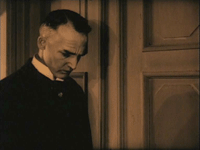
It perhaps comes as no surprise, given Carl Theodor Dreyer’s lifelong, idealized melancholy over his own unresolved parentage, that the scenario selected for his first film, The President would involve three generations of children conceived out of wedlock, and thematically crystallize on the legacy of their unreconciled paternity in the resolution of their own disparate […]
Category: Directors
Nathaniel Dorsky: Winter and Sarabande (2008)
Bookending with representations of twilight – an opening shot of light transmitted through a foregrounding grating, and a closing shot of the sun setting below a line of trees – Nathaniel Dorsky’s Winter and Sarabande convey forms of progression: a movement from dawn to dusk, shadow to light, grey tones to color, emptiness to space. […]
A Christmas Tale, 2008
Returning to the recurring themes of parental alienation and surrogacy of La Vie des morts, Playing “In the Company of Men”, and Kings and Queen, A Christmas Tale is a quintessential Arnaud Desplechin film in its ingenious, heady collision of disparate, often contradictory, yet integrally interconnected forms. On one level is the intersection of savior […]
Kings and Queens, 2004
In a subtly revealing scene that occurs in the first hour in Desplechin’s intelligently conceived, incisive, and immensely engaging film Kings and Queen, a woman in her late thirties named Nora (Emmanuelle Devos) stops to visit a powder room after a frantic all-night drive from Grenoble to Paris in order to check her appearance, fix […]
Playing “In the Company of Men”, 2003
Arnaud Desplechin’s fractured, self-reflexive portrait of corporate anomie, based on British author Edward Bond’s play In the Company of Men, is a frustratingly disjointed and excessively soundtracked (often with unnecessarily cranked up, thematically unrelated music from Paul Weller and The Jam that renders the dialogue inaudible) that is punctuated with episodes of fractured clarity. Fusing […]
How I Got Into an Argument… (My Sex Life), 1996
Arnaud Desplechin’s films may be anarchic and free-formed, but they are never without a sense of internal logic and intelligent construction. This liberating sense of organic structure is particularly evident in the opening sequence of How I Got Into an Argument… (My Sex Life): a napping assistant professor and seemingly perennial doctoral candidate, Paul Dedalus […]